
Why your tablet coating machine has plenty of splatters

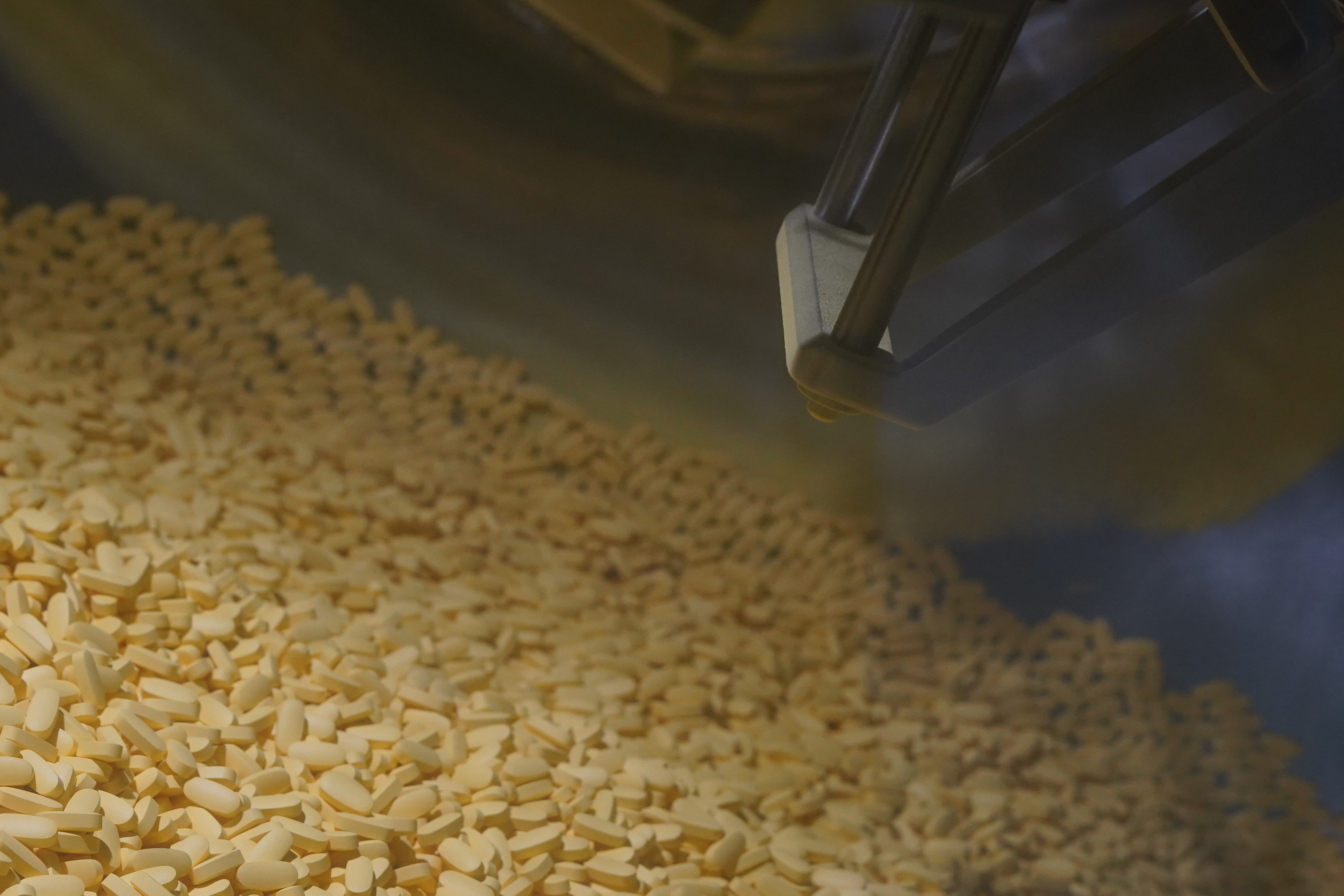
At the end of a film-coating run, the inside of the coating pan says a great deal about how well the process performed. In a well-controlled run, the coating stays on the tablets. In a poorly controlled one, it also ends up on the pan walls, the baffles, and the inspection window.
Splatter is more than a cleaning job. Every drop that misses the tablets wastes coating material, adds cleaning time between batches and raises the risk of contamination. In most cases, it comes down to two things: where the nozzle sits and what the spray looks like when it leaves the nozzle.
Cause 1: the nozzle is too far from the tablet bed
Think of watering a garden with a hose. Stand too far back and the spray drifts onto the path. Stand too close and you flood one spot.
Coating works the same way. As the gun-to-bed distance increases, droplets can start drying before they reach the tablets, which lowers coating efficiency and roughens the surface (Seo et al., 2020). Droplets that travel further are also more likely to be carried by the airflow onto the pan and window. Too close, and the bed gets over-wetted.
The right distance changes with batch size, tablet shape and formulation. A nozzle set for a full batch is usually too far away for a half batch.
On the XT Coater, the nozzle position and angle are adjustable, so operators can match the spray to the bed for each batch.

Cause 2: the spray pattern is out of control
A wide spray is not a problem in itself. It can even improve uniformity, because more tablets pass through the spray at once (Brock et al., 2014). The trouble starts when the spray spreads beyond the tablet bed, or when neighbouring nozzles overlap and double-wet the same tablets.
A common culprit is bearding. Dust and dried droplets circulating in the pan slowly build a crust on the nozzle tip. As it grows, it distorts the spray and makes the nozzle spit larger droplets in random directions. Those droplets become splatter.
On the XT Coater, the STV non-bearding nozzle, manufactured in-house from a proven European nozzle design, uses a rounded orifice that reduces turbulence at the nozzle tip. Less turbulence means less buildup, so the spray pattern holds steady from the start of the run to the end. The adjustable exhaust air chamber supports this by guiding process air horizontally, away from the nozzle area.

What you gain when using STV Machine XT Coater
Less material wasted: more coating ends up on the tablets
Faster cleaning: less residue on the pan, baffles and glass
Lower contamination risk: fewer hard-to-clean deposits
More consistent tablets: fewer over-wetted or rough spots
Discuss Tablet Coating with Us
Let's discuss granulation and tablet coating! Meet us at our next big event, ALLPack Indonesia, 20–23 October 2026, JIExpo Kemayoran, Jakarta.
References
Brock, D., Zeitler, J.A., Funke, A., Knop, K., & Kleinebudde, P. (2014). Evaluation of critical process parameters for inter-tablet coating uniformity of active-coated GITS using Terahertz Pulsed Imaging. European Journal of Pharmaceutics and Biopharmaceutics.
Seo, K.-S., Bajracharya, R., Lee, S.H., & Han, H.-K. (2020). Pharmaceutical application of tablet film coating. Pharmaceutics, 12(9), 853.


