
Why Granules Come Out Uneven From a Fluid Bed Dryer And How STV Machine Solves It

Updated: Jul 1

In pharmaceutical solid dosage manufacturing, the fluid bed dryer is one of the most critical steps in the granulation process. Get it right, and granules come out with consistent moisture content, ready for the next stage. Get it wrong, and the batch is uneven with some granules over-dried, others still wet, and the downstream process pays the price. This is not an uncommon problem. It happens regularly with conventional fluid bed dryers, and in most cases, the root cause is the same: how the air moves inside the machine.
How a Conventional Fluid Bed Dryer Works And Where It Falls Short
In a conventional fluid bed dryer, heated air enters the machine from below and passes upward through a wire mesh or perforated plate that spans the entire base of the product chamber. The idea is that the air lifts the granules off the base and keeps them suspended and fluidised, while the heat dries the moisture out.
In practice, the airflow from a full perforated plate is spread across the entire base of the chamber. Because the air has to travel through every point of that plate simultaneously, the velocity at any single point is relatively low.

This creates a specific problem: wet granules are heavy. When the airflow is not strong enough to keep them fully in motion, they settle. Settled granules cluster together and physically block the airflow beneath them. The air finds the path of least resistance — the gaps between clusters — and passes through those gaps instead. This is called channeling.
The consequence of channeling is that some granules are exposed to full airflow and dry quickly, while others sit in low-airflow pockets and remain wet. The batch exits the dryer with uneven moisture content. Granule quality is inconsistent.
Why Channeling Is Difficult to Solve With Conventional Technology
The fundamental issue is that conventional fluid bed dryers rely on upward-only airflow. Air goes up, granules go up, gravity brings them back down. The movement is essentially vertical and there is no lateral or rotational force acting on the particle bed.
When granules settle and cluster, the only force available to break them apart is the upward air pressure. If that pressure is insufficient because the airflow is spread too thin across the full plate, the clusters stay intact, channeling continues, and drying remains uneven throughout the run.

The STV Machine Approach: Bottom Plate STV Disk Jet
STV Machine's response to this problem is the Bottom Plate STV Disk Jet, a fundamentally different approach to how air enters the product chamber.
Rather than distributing air across the entire base of the chamber through a perforated plate, STV Machine concentrates the airflow. The air is delivered through a focused path directly beneath the Disk Jet plate, which means the same volume of air from the same air handling unit, exits with significantly higher velocity at the point of contact with the granule bed.

That focused, high-velocity air hits the angled vanes of the Bottom Plate STV Disk Jet and is redirected, not straight up, but in a tangential, rotating direction. The granules do not simply rise and fall. They move in a cyclone airflow, continuously rotating through the chamber.

This cyclonic movement means no granule stays in one position long enough to settle, cluster, or block airflow. Channeling does not occur. Every granule is continuously in motion, continuously exposed to the heated airflow, and continuously drying at the same rate as every other granule in the batch.
What This Means for Your Granules
The practical outcome of a cyclone airflow is drying that is more uniform across the entire batch, not because the process is monitored more carefully, but because the particle movement makes uneven drying geometrically difficult to sustain.
Granules that move in a consistent cyclonic pattern do not have the opportunity to cluster or channel. The high-velocity, focused air keeps the bed in continuous motion throughout the run. The result is a batch where granules exit with consistent moisture content across the full product container with the same quality at the top of the bed as at the bottom, and the same quality at the start of the run as at the end.
For manufacturing teams where batch consistency is a quality requirement and not just a preference, this is the difference the Bottom Plate STV Disk Jet delivers.
From Lab to Production: STV Combilab 5 and the STV SD(GC) Series
The Bottom Plate STV Disk Jet technology is built into both the Combilab 5 (STV Machine's laboratory and R&D scale fluid bed dryer) and the STV SD(GC), the production-scale fluid bed dryer for full manufacturing volumes.
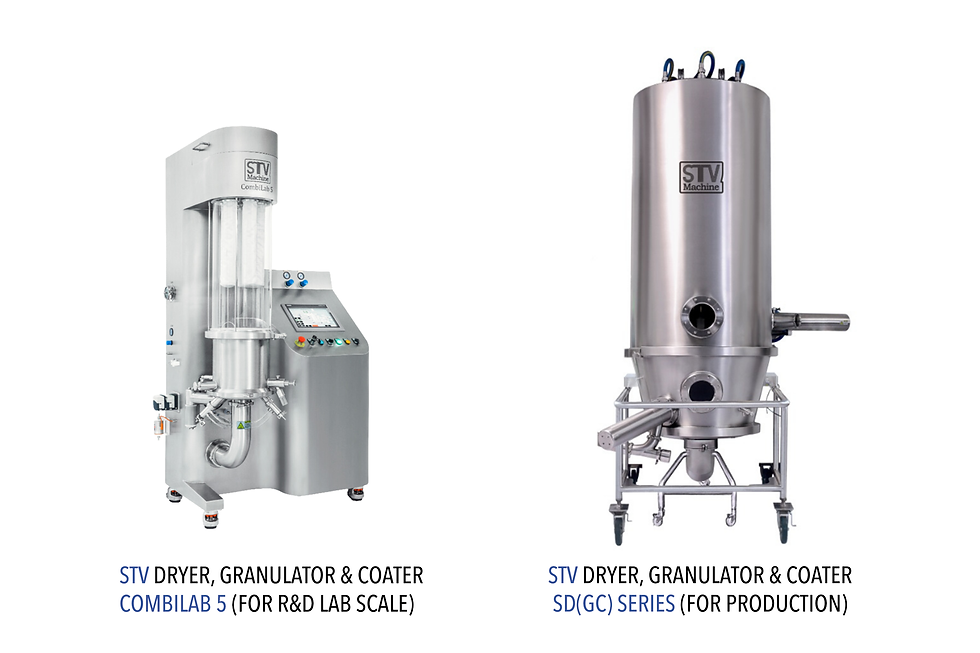
The Combilab 5 operates at 2–5 kg batch sizes, making it the right starting point for formulation development, process trials, and scale-up feasibility. Because both machines share the same airflow technology, the process behaviour observed at lab scale on the Combilab 5 is directly relevant when scaling up to the SD(GC) for production.
See It, or Try It Yourself
The best way to understand what cyclonic airflow does to a granule bed is to see it in action.
If you would like to see the machine or bring your own materials for a trial run, our facility in the Jakarta Greater Area and our manufacturing centre in Ho Chi Minh City are available for visits and product trials by appointment.
To arrange a visit, a trial, or a conversation: sales@stvmachine.com.vn
or fill in the contact form below!


